Start with the report’s job
Binding turns loose pages into a document that is easier to distribute, store, and use. Before choosing a machine, consider what happens after the report leaves your desk. Will readers write in it at a meeting? Will the contents change next month? Does it need to sit neatly on a shelf or open beside a keyboard? Those questions are more useful than choosing by appearance alone.
Also estimate your typical page count and how many copies you make at once. A small office producing occasional short reports may value a simple process and modest storage needs. A team assembling many copies regularly may care more about punching speed, consistent alignment, and how quickly each finished document can be checked. Binding machines and supplies have model-specific limits, so compare their stated sheet capacities with your real documents, including covers.
Comb binding: practical when pages may change
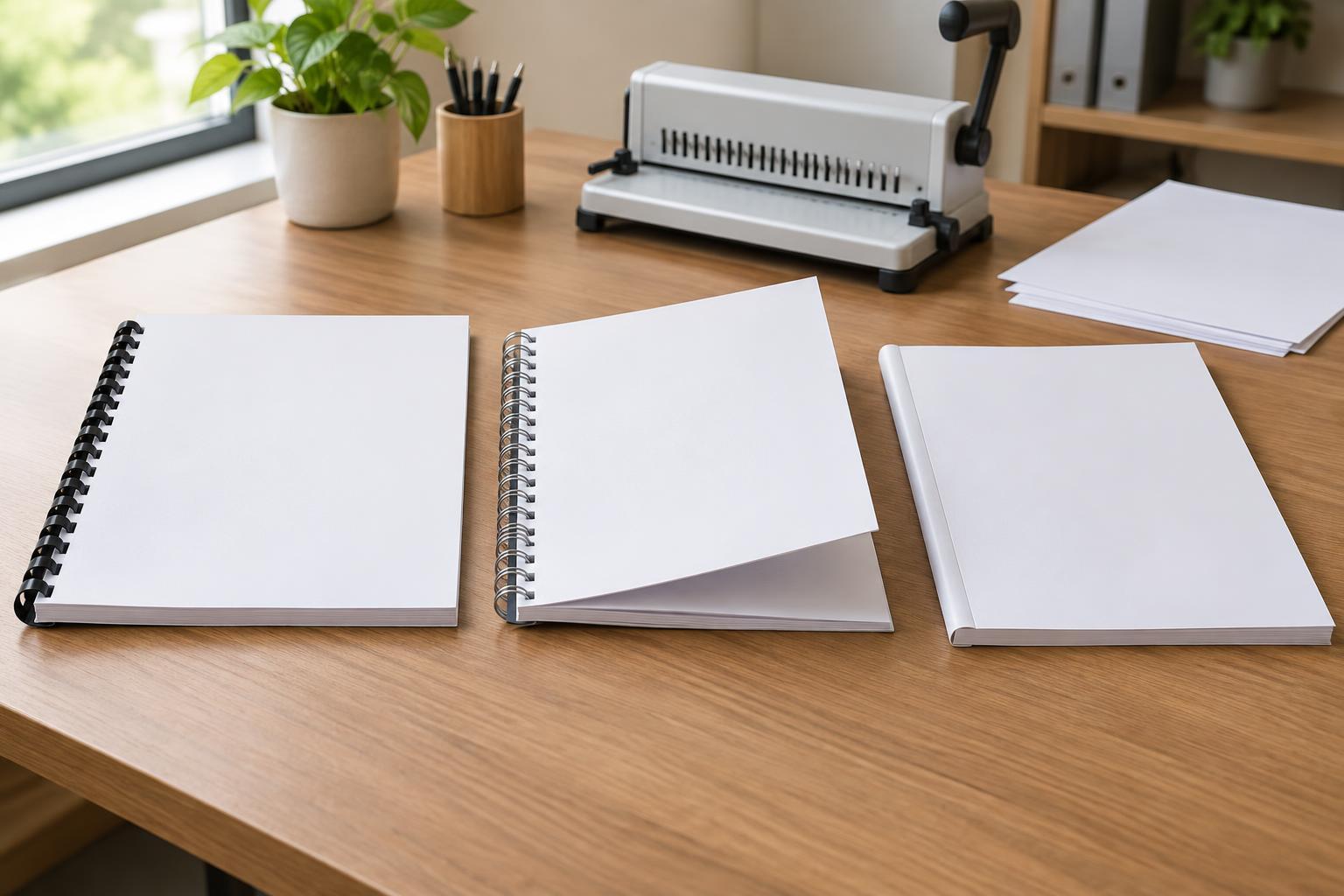
Plastic comb binding uses a row of holes punched along the page edge. The machine opens a plastic comb so you can place the pages over its fingers, then closes it to hold the stack. Many comb-bound reports open widely and can lie reasonably flat, which helps when readers need to consult them on a desk. The comb remains visible along the spine, giving the document a functional rather than seamless finish.
Its main advantage is revision. With the appropriate machine, you can reopen the comb, replace a page, and close it again. That makes comb binding a useful choice for manuals, draft reports, and documents updated in small batches. Assembly still takes care: pages need to be punched in the correct orientation and kept in order. Check that the machine’s punch pattern matches the combs you plan to buy, and confirm its punching capacity separately from the maximum number of pages it can bind.
Wire binding: easy page turning and a tidy profile
Wire binding also starts with punched holes, but uses a metal loop that is closed around the pages. It gives reports a slim, orderly appearance and generally lets pages turn freely, often all the way around to the back. That can be especially useful for training notes, reference documents, and reports used where desk space is limited.
The trade-off is editing. Once a wire has been closed, replacing a page usually means removing or cutting the wire and binding the document again with a new one. Wire can also bend if a report is packed or handled roughly. If you choose this method, check both the hole pattern and the compatible wire size before ordering supplies. Look at how the machine helps align the wire during closing, too: an unevenly closed loop can make pages harder to turn or leave the finish looking untidy.
Thermal binding: a clean spine with fewer assembly steps
Thermal binding typically places an unpunched stack of pages into a cover with adhesive in its spine. The machine heats the spine to secure the pages, after which the document needs time to cool and set according to the equipment and cover instructions. Because there are no punched holes or exposed loops, the result can resemble a slim softcover report.
This method suits finished documents that are mainly read and filed, such as presentation copies or completed proposals. It is less convenient for working documents: pages are not intended to be swapped routinely, and a thermally bound report generally will not stay open as readily as a comb- or wire-bound one. The cover must suit the stack thickness, and you should follow the machine’s instructions for loading, heating, and cooling. If your office prepares mixed page counts, check the available cover sizes before committing to the system.
Choose for your workflow, then test a sample
For changing content, comb is usually the most forgiving option. For a report that readers will keep open, flip through, or fold back, wire may be the better fit. For a final copy where a plain, covered spine matters more than editability, consider thermal binding. None is universally best: a polished-looking report that will not stay open can be frustrating, while an easily revised document is less valuable if revisions never happen.
Before buying equipment, bind a sample that matches your usual report, including its paper and covers. Turn every page, set it on a desk, and see how it fits in your storage space. Then compare the complete routine: preparation, punching or heating, assembly, cooling if required, and checking the result. Allow space for both the machine and its supplies. A method your team can use accurately and repeatably is more useful than one chosen solely for its finished appearance.