Start with what you need to destroy
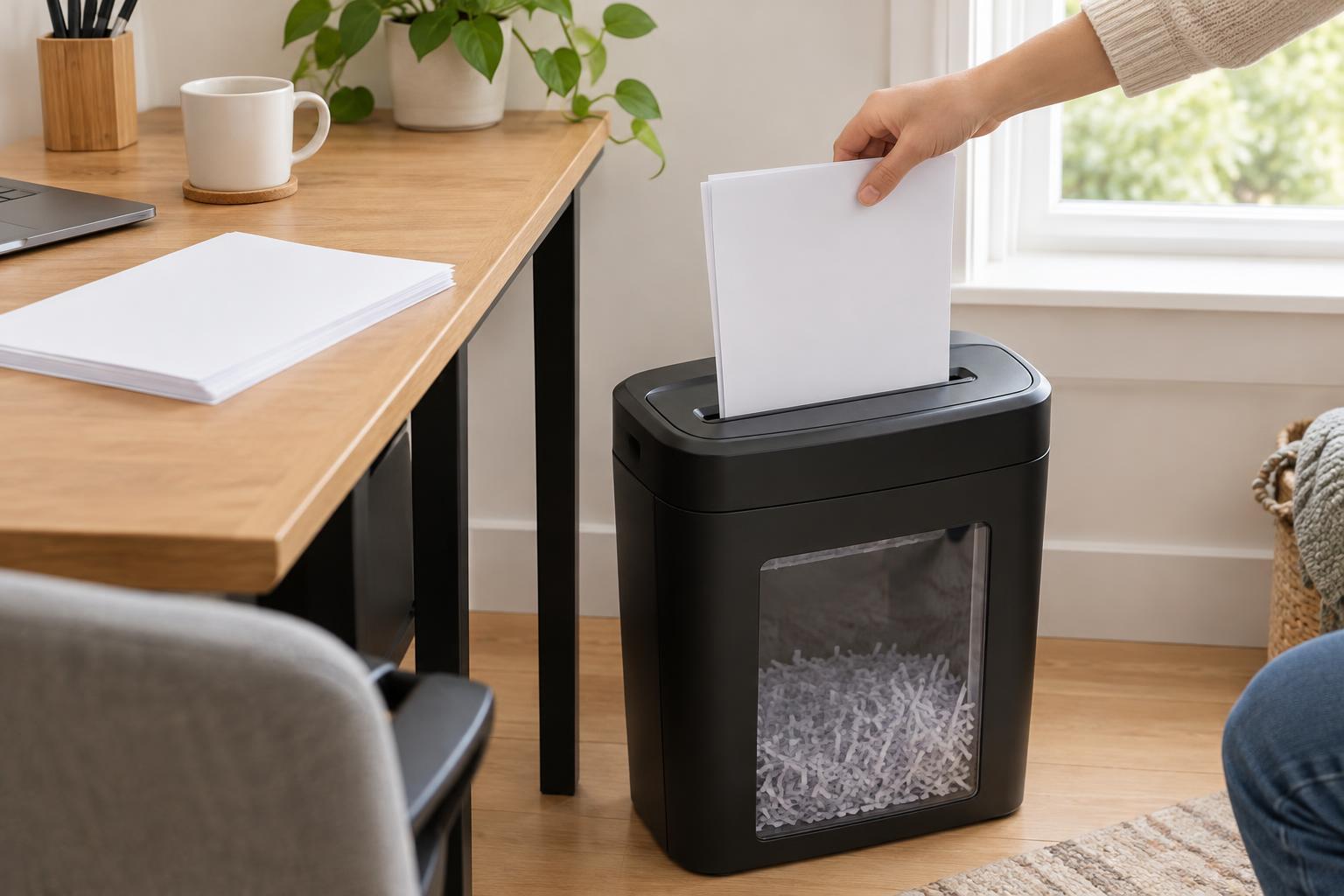
A paper shredder is easiest to choose when you picture an ordinary week of disposal. Do you shred an occasional letter, a few pages after each workday, or a box of old files every month? The answer matters more than a long list of extra features. A small shredder may suit one person handling mail, while a shared workspace may need a machine that can process repeated batches without frequent stops.
Also consider what goes into the shredder. Paper is the baseline, but some models accept staples, paper clips, cards, or discs, and others do not. Check the stated capabilities rather than assuming a larger machine handles every material. If several people will use it, a clearly marked place for documents awaiting shredding can help prevent papers from piling up beside the machine.
Choose a cut type that fits the documents
Strip-cut shredders turn a page into long, narrow strips. They can be a straightforward choice for low-sensitivity material, but the strips retain more of the original page than smaller-cut alternatives. Cross-cut shredders cut paper in two directions, producing shorter pieces. For many home offices, this offers a practical balance between document disposal, bin space, and ease of use.
Micro-cut shredders produce much smaller pieces and are worth considering when you regularly discard documents containing personal, customer, or business information. Smaller pieces generally make a page harder to reconstruct, but “micro-cut” alone does not tell you the exact particle size. If your workplace has a specific document-disposal requirement, check the shredder’s stated cut size or security classification against that requirement.
Finer cuts can affect convenience. A micro-cut model may process fewer sheets per pass or need more time for the same stack than a comparably sized cross-cut model, although designs vary. The smaller pieces may also pack differently in the bin. Compare the actual models you are considering rather than treating cut type as a complete measure of performance.
Treat sheet capacity as a limit, not a target
Sheet capacity is the maximum number of sheets a shredder is rated to accept in one pass. It is useful for comparison, but it does not mean every stack of that size will feed equally well. Thicker paper, folded pages, staples, and uneven stacks can increase resistance. Feeding a little below the rated limit is often less frustrating than repeatedly pushing the machine to its maximum.
Match capacity to how you work. If you usually shred one or two pages as soon as you finish with them, a high sheet capacity may bring little benefit. If you clear files in batches, a wider feed opening and a higher capacity can reduce the number of passes. An auto-feed model may be convenient for stacks, but check what its tray accepts: its automatic capacity and its manual-slot capacity may differ, and not every document belongs in an unattended feed tray.
Check run time, cool-down time, and bin size together
Run time describes how long a shredder is designed to operate before it needs a pause; some product descriptions call this a duty cycle. A model rated for only a short continuous run may work well for daily mail but interrupt a large cleanout. Look at the required cool-down period too. A longer run time is more useful when the machine can return to service on a schedule that fits your workload.
Bin size shapes the same experience. A small bin can fill quickly during batch work, especially if bulky scraps collect near the cutting head. Check whether the bin is easy to remove and whether you can see when it is nearing full. For a shared office, think about who will empty it and where the shredder will sit: a machine that blocks a walkway or is awkward to access may be used less consistently.
Look for easy, safe everyday operation
Useful features include a reverse control for minor jams, an automatic stop when the bin is removed, and clear indicators for overheating or a full bin. Noise may matter if the shredder sits beside a desk or near calls. If children or pets can reach the workspace, pay particular attention to the feed opening, controls, and the manufacturer’s safety guidance.
Before buying, compare three things in order: the cut you need, the amount of paper you feed at once, and how long you expect to keep feeding it. Then use bin design, accepted materials, noise, and maintenance instructions to choose between suitable models. Once installed, empty the bin before it overfills and follow the manufacturer’s guidance for cleaning or lubrication. These habits can help the shredder handle routine work without turning every disposal session into a jam-clearing task.