Start with the job each device does
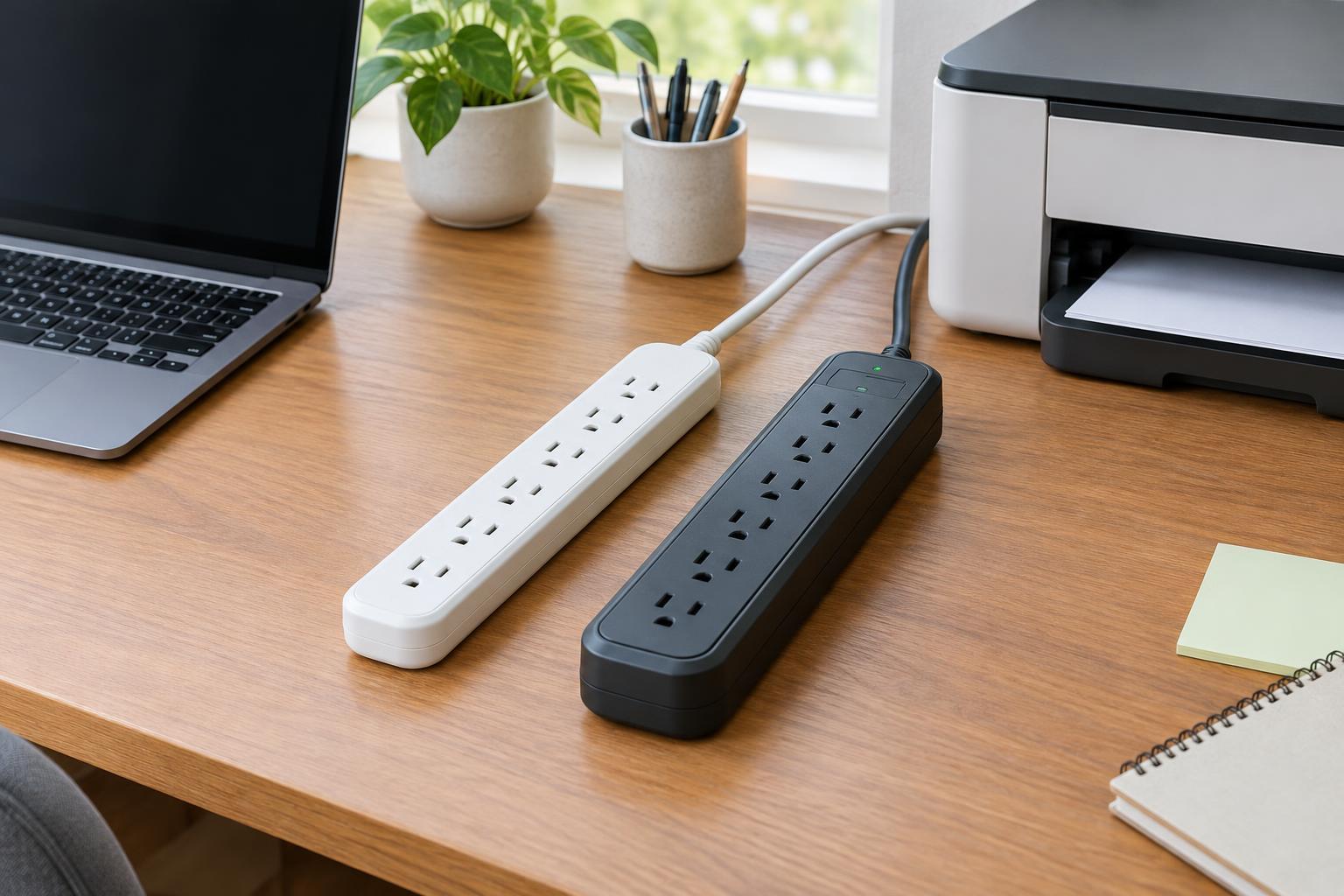
A basic power strip turns one wall outlet into several places to plug in equipment. It does not necessarily protect that equipment from a voltage surge. A surge protector also provides outlets, but includes components designed to divert some brief voltage spikes away from connected devices. Both can be useful in a home office, but the extra outlets alone do not tell you which one you have.
Check the product label or packaging for an explicit surge-protection rating rather than relying on words such as “heavy-duty” or “protected.” Neither device is a substitute for enough properly located wall outlets. Do not connect one strip to another, run a cord under a rug or use a strip where its cord or plug could be damaged.
Read the electrical capacity first
The amp rating describes how much current the strip is designed to carry. A watt rating may also appear on the label. In a 120-volt setting, watts are approximately volts multiplied by amps, so a strip marked 15 amps may be labeled for up to 1,800 watts. That is a maximum rating, not a target for a routine office setup. The wall circuit may serve other equipment too, and a device can briefly draw more power when starting.
Count the equipment you plan to plug in, not just the available sockets. A monitor, laptop charger, router and desk lamp are different loads from a space heater or some printers. Check equipment manuals and labels: manufacturers of higher-draw devices, including some laser printers, may instruct you to plug them directly into a wall outlet. Never use a strip to get around those instructions or a tripping breaker.
What surge-protection ratings can tell you
A joule rating indicates how much surge energy a protector is designed to absorb under its stated test conditions. A higher number can be useful when comparing otherwise similar products, but it does not promise that every spike will be stopped or that the protector will last a set number of years. Surge-protection components can degrade after repeated events, sometimes without an obvious outward sign.
You may also see a voltage protection rating or clamping-voltage figure. Broadly, it describes the voltage level associated with the device’s response during a specified test. Lower is not automatically better in every comparison: test methods and other design details matter. For products sold in the United States, a listing to UL 1449 is a more useful sign that a surge protector was evaluated to a relevant safety standard than an impressive-sounding number on its own. Read the exact label rather than assuming every power strip has that listing.
An indicator light may show that surge protection is still functioning, while a separate light may indicate a grounded outlet. The meanings vary by model, so consult its instructions. A lit indicator is not a guarantee against equipment damage, and a surge protector cannot correct every wiring problem or protect against every prolonged voltage fault.
Match the device to the workspace
For a desk with a computer, monitor and networking equipment, a listed surge protector with enough spaced outlets, an appropriate load rating and a cord long enough to reach the wall without strain is often a practical choice. Outlet spacing matters if several power adapters are bulky. A basic power strip may be adequate where you need extra outlets for equipment that does not call for surge protection, provided its capacity and instructions fit the use.
If you need time to save work during an outage, look at an uninterruptible power supply, or UPS, rather than expecting a surge protector to provide backup power. A UPS has its own load and battery-runtime limits. For printers and other devices with high startup demands, check the UPS and printer instructions before connecting them; a convenient open socket does not mean the combination is supported.
Make the setup easy to inspect
Place strips where air can circulate and where you can see the cord, plug and indicator lights. Keep paper stacks and other clutter away from plugs. Replace a device with a damaged cord, loose sockets, scorch marks or a failed protection indicator according to its instructions. If an outlet is ungrounded, a plug feels unusually warm or a breaker trips repeatedly, stop using that setup and have the underlying issue checked by a qualified person.
The simplest buying sequence is to decide what equipment needs outlets, check its power requirements, choose a device with suitable capacity, and then compare surge-protection ratings if protection is needed. That approach is more dependable than choosing by outlet count or joules alone.