Start with the mail you send
A postage scale is most useful when it matches your usual mailing work. Before comparing models, make a short list of what you send: single letters, padded envelopes, document packs, small boxes, or a mix. Think about the heaviest parcel you expect to weigh as well as the lightest item. A scale that handles a large box may be less convenient for a thin envelope, while a compact letter scale may reach its limit as soon as you add packaging.
Also consider where weighing fits into your workflow. If you print labels at a desk, a small scale beside the printer may be ideal. If you pack boxes at a separate table, a larger platform may be worth the space. You do not need to choose the biggest scale available; you need one that can weigh your finished packages without crowding the work area.
Match the weight range to your packages
A scale’s capacity is the maximum weight it is designed to measure. Choose a capacity above the weight of your typical packed item, with some room for occasional heavier shipments. Remember to include the box, filler, tape, and label when judging that weight. If your work ranges from letters to substantial parcels, two scales may be more practical than forcing one model to cover both extremes.
Check the lower end of the range, too. Some scales list a minimum measurable weight or perform less consistently with very light items. If you regularly mail single sheets or lightweight envelopes, confirm that the scale can register those items. For parcels that exceed your scale’s capacity, use a suitable higher-capacity scale rather than trying to balance or divide the package.
Understand what precision tells you
Display precision is the size of the steps shown on the screen, sometimes called readability or resolution. A scale that displays smaller increments can show finer differences in weight. That does not automatically mean every reading is equally accurate: accuracy is how closely the result reflects the item’s actual weight, while repeatability is how consistently the scale reads the same item. Compare the specifications for all three where the manufacturer provides them.
Finer increments are especially helpful when a small change in weight could affect the postage option you select. For heavier boxes, tiny display steps may add little practical value. Whatever scale you choose, place it on a firm, level surface, let the reading settle, and weigh the fully packed item. If a reading is close to a service’s weight limit, check it again rather than relying on a single glance.
Choose a platform that supports the item
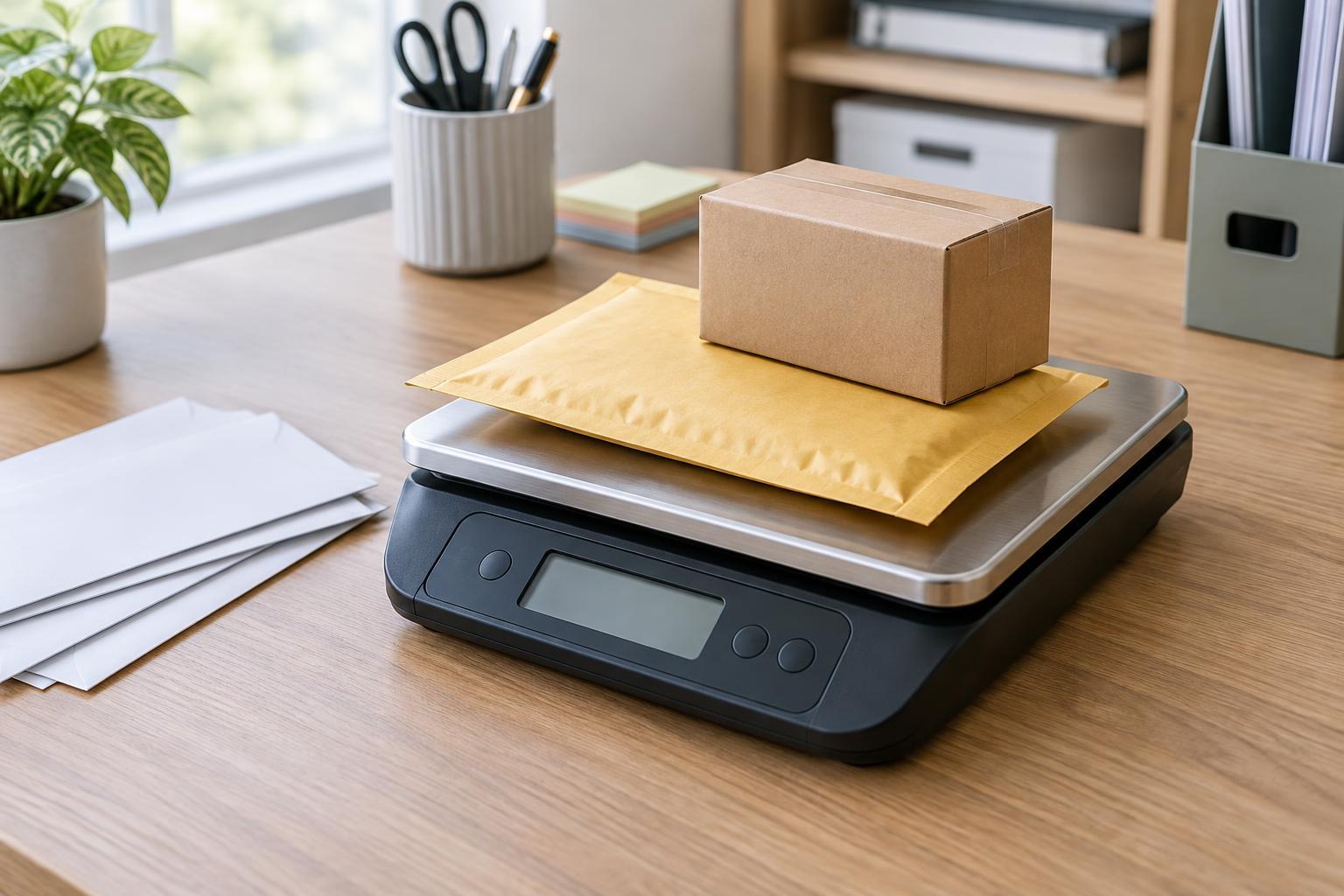
Platform dimensions matter separately from weight capacity. A scale may support a parcel’s weight yet have a surface too small to hold it securely. Compare the platform with the base of your usual boxes, not just their total height or length. A package should rest stably without tipping or pressing against nearby objects, which could interfere with a reading.
Large envelopes present a different problem: they may cover the display even when they weigh very little. A raised display, a remote display, or a hold function can make the result easier to read. Hold keeps a settled reading visible after you remove the item, if the model offers it. Check how you would weigh awkward shapes as well as standard boxes, but avoid balancing an unstable parcel on a small platform.
Check the everyday details before buying
Useful features depend on how you work. A tare button resets the display to zero after you place an empty container on the scale, so you can weigh its contents separately. Clear unit options help if your mailing process uses different units. Battery power offers flexibility; an adapter can be convenient at a fixed packing station. An easy-to-read display and controls you can use with one hand may matter more in daily use than a long feature list.
Finally, treat the scale as a measuring tool, not a complete postage calculator. Postal and shipping services may use packaging dimensions, service rules, or other details alongside weight. Follow the service’s current instructions when buying a label. Keep the platform clean, avoid overloading it, and check the manual for any calibration or care steps. A well-chosen scale should make the weighing step simple and repeatable, leaving you free to focus on packing and sending the item.