Start with the cuts you make most often
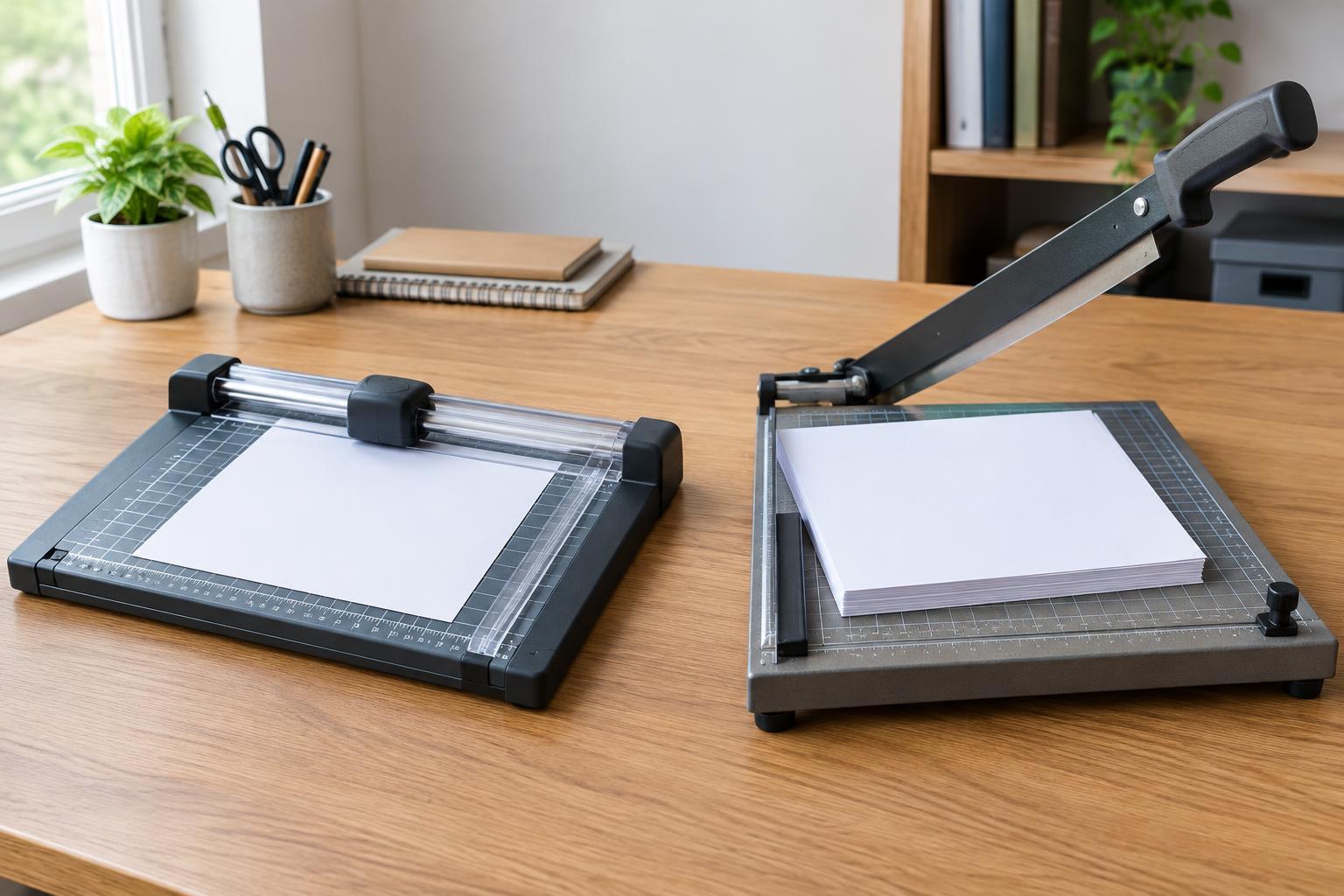
A paper trimmer is useful when scissors are too slow or inconsistent, but the best type depends on what you cut. A rotary trimmer moves a cutting head along a fixed rail. A guillotine trimmer brings a hinged blade down across the paper. Both can produce clean, straight edges; neither guarantees an accurate result without careful alignment.
Before comparing models, note the largest sheet you need to cut, how many sheets you usually cut at once, and how exact the finished dimensions must be. Trimming one printed handout to fit a folder is a different job from repeatedly cutting stacks of flyers. If you work with card stock, laminated pages, or labels, check that those materials are explicitly supported by the model you consider.
Rotary trimmers favor controlled, small-batch work
On a rotary trimmer, the cutting head follows a rail, making its path easy to anticipate. This can help with deliberate cuts on individual pages, photographs, or a few sheets that must line up with a printed edge. Many designs keep the blade within the moving head, though the degree of blade exposure varies. A clear cutting guide, readable measurement marks, and a firm paper clamp can matter more to accuracy than the cutting mechanism alone.
Rotary models generally call for more passes when a job involves large stacks. Trying to cut beyond a trimmer’s stated capacity can pull paper out of position or leave uneven edges. If you often make small adjustments, look for a base with measurements you can read comfortably and a rail that does not obstruct the edge you need to see. Some models offer interchangeable cutting heads, but check which heads are included rather than assuming a particular cut style comes with the trimmer.
Guillotine trimmers favor repeated stack cuts
A guillotine trimmer is often the more convenient choice for cutting a stack to the same size in one motion, provided the stack stays within its stated capacity. That makes it appealing for routine office tasks such as sizing batches of handouts. A solid base, clear grid, adjustable fence, and effective hold-down can help keep sheets square. Without a dependable way to hold the paper, the top and bottom sheets may shift even when the blade is sharp.
The long hinged blade needs more attention to handling and storage. Compare guards, blade latches, and how securely the arm rests when the trimmer is not in use. Keep hands away from the cutting path and follow the model’s operating instructions. If the trimmer will be shared or stored in an accessible area, these features deserve as much consideration as sheet capacity.
Compare capacity and precision separately
A higher sheet-capacity rating tells you how much a trimmer is intended to cut at once; it does not tell you how accurately it will cut every stack. Capacity also depends on the paper being used. Thick stock takes up more of a trimmer’s cutting allowance than ordinary copy paper, so compare manufacturer limits for the materials you actually use.
For precise sizing, look at how the tool supports repeatable alignment. A square fence or backstop helps when every piece needs the same width. Visible measurement marks help with occasional custom sizes, while a clamp helps prevent a stack from moving. If possible, test a trimmer with your usual paper: align a small stack, cut it, and check whether the corners remain square and the sheets match. That simple check reveals more about your workflow than choosing by blade type alone.
Make the choice fit your workspace
Choose a rotary trimmer if your work is mostly single sheets or small batches and you value controlled positioning for each cut. Choose a guillotine trimmer if you regularly size moderate stacks and have room to operate and store its arm safely. For a mixed workload, consider which task consumes more time: repeated small cuts or repeated stack cuts. One trimmer may handle both, but its strengths will still reflect its design and rated limits.
Finally, consider upkeep. Paper dust can obscure guides, dull blades can tear edges, and loose or damaged parts can affect alignment. Check whether replacement cutting parts are available for the model and how they are changed. A trimmer that fits your usual paper, stays stable on the desk, and is easy to maintain is likely to be more useful than one chosen solely for its maximum advertised capacity.